Other local tributes to the artist: the tunnel named for DR (instead of the usual engineer) that goes from Paseo de la Presa in the direction of the bus station -- and a bizarre bronze statue on Juan Valle that shows what he would have looked like with short legs. Nationally, the 500 peso note, with Rivera on one side and Frida Kahlo on the other.
My main Mexican blog is MEXIGUANA www.rochellecashdan.blogspot.com but here I post other tidbits, especially photos of art exhibits in Guanajuato, along with my translation of a famed Guanajuato legend. To read my online stories and poems, google rochelle cashdan.
Saturday, 14 March 2015
Guanjuato Reclaims Diego Rivera: last day of special exhibit Sunday, March 15
As part of a whole month of honoring Diego Rivera, born here, the Casa Museo Diego Rivera, is hosting a special exhibit of his works on loan. As you enter, you will see one of his cubist works, painted during the years he lived in Paris. For viewers who know his murals but not his easel work, the exhibit is a revelation, as are also the three large bronze reliefs made from his sketches. And look for a drawing the versatile artist made of a rural US scene.
The traveling exhibit is on the first floor. Take the elevator up one floor more to see works that are always on view at the Museum, both by and of Rivera.
Other local tributes to the artist: the tunnel named for DR (instead of the usual engineer) that goes from Paseo de la Presa in the direction of the bus station -- and a bizarre bronze statue on Juan Valle that shows what he would have looked like with short legs. Nationally, the 500 peso note, with Rivera on one side and Frida Kahlo on the other.
Thursday, 12 March 2015
Guanajuato: MuAG (Women Artists of Guanajuato)
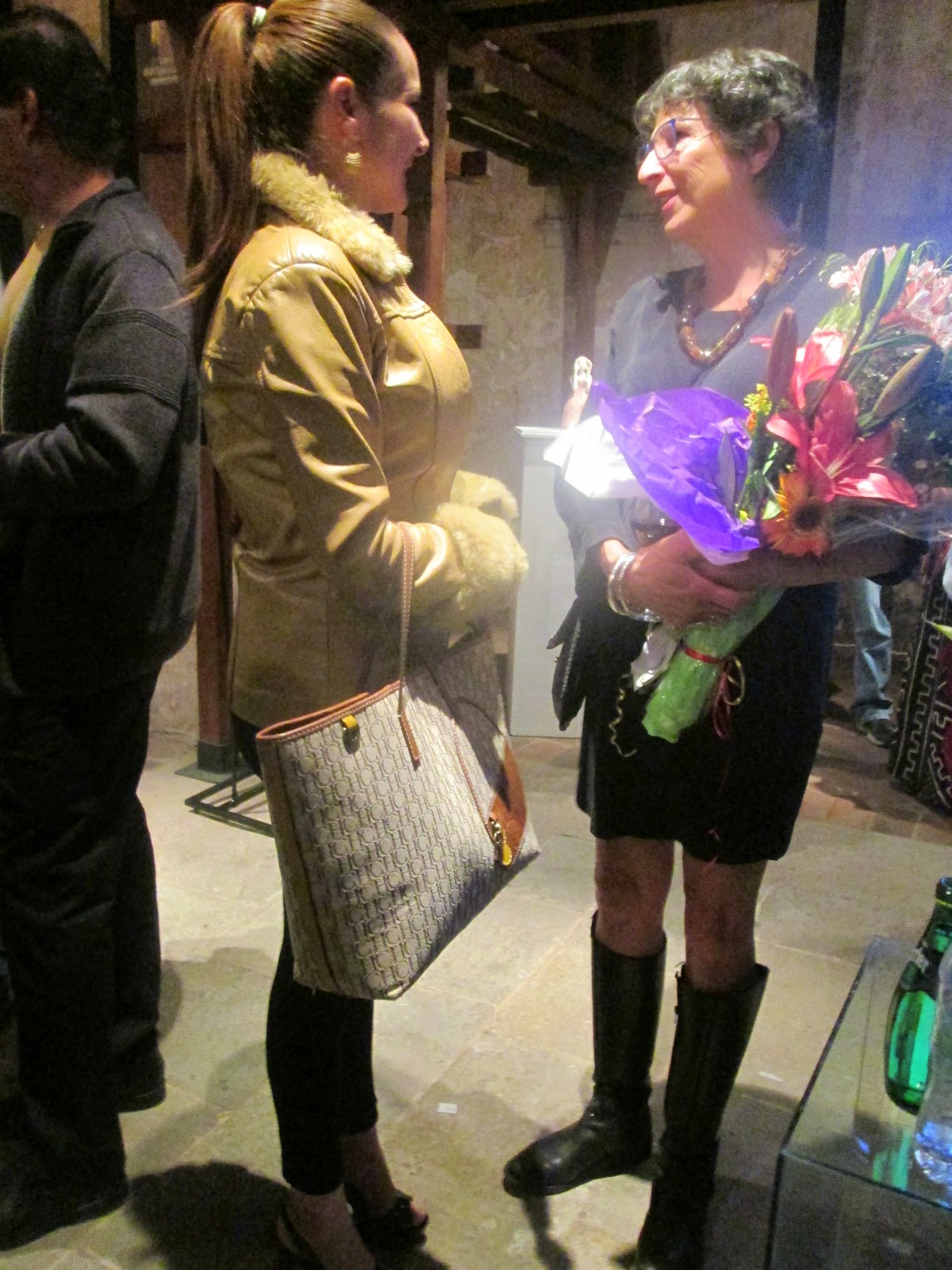
Twenty-three artists showed their work in the VII edition of Mujeres Artistas de Guanajuato that opened tonight in the Dieguino Museum next to Teatro Juarez. At the bottom, Loreta, the organizer, happy afterward. Talina Rodríguez created the image of Coatlicue, the mother of the Aztec gods, the photo not as sharp as I would like it, better to see it for yourself. To see pre-Hispanic sculptures of Coatlicue, google "Coatlicue images."
The one sculpture and the 22 paintings all featured women. I always like going into this museum that blends convent ruins with a modern approach to natural light.
Sunday, 1 February 2015
Guanajuato Artists: Kate Delos at 81 Positos through February
Kate's double exhibit, Obras en dos partes, is just what the title says. The rear galleries on the ground floor show Delos's work based on nude figures, the front gallery --my pick--shows more recent work suggested in part by Guanajuato colors and shapes, with the artist working her magic on both parts. An expo-venta.
| entrance hall to the three-floor gallery |
| detail from "The Weight of History" |
Tuesday, 27 January 2015
20th Century Italian Artists at MAHG, Leon until January 31
My visits to Leon run the gamut, this time from eating tacos in a place I like a block off Lopez Mateos, walking to the art museum, and afterward stopping off at Costco.
Above and beside, two toys I saw at the exhibit Mexican Toy Exhibit just ended, but they should all be back on permanent display at San Miguel's Toy Museum by now.
Below, a sampling of the variety in the Italian
exhibit: one of two striking fabric sculptures made of painted canvas; an embroidered geometric "painting" made up of tiny stitches; and of course, other paintings in many different styles, of which the horses by de Chirico shown are so different from the architectural-surreal painting we usually see reproduced.
Informative texts to guide the viewer through the exhibit.
This exhibit of 20th century art from Italy is fascinating for showing how art crosses borders, both in themes and techniques. Highly recommended if you are going to Leon on a weekday as the traffic is slow and sidewalks crowded with the annual Fair in full swing.
By the way, the fully accessible museum building and galleries are world class. The bookstore there has piles of good reads and picture books in Spanish.
| The shopping bag even had the lettering we are used to seeing |
| Constance prompted me to watch for the loom |
Below, a sampling of the variety in the Italian
exhibit: one of two striking fabric sculptures made of painted canvas; an embroidered geometric "painting" made up of tiny stitches; and of course, other paintings in many different styles, of which the horses by de Chirico shown are so different from the architectural-surreal painting we usually see reproduced.
Informative texts to guide the viewer through the exhibit.
This exhibit of 20th century art from Italy is fascinating for showing how art crosses borders, both in themes and techniques. Highly recommended if you are going to Leon on a weekday as the traffic is slow and sidewalks crowded with the annual Fair in full swing.
| Children's Room for classes (no one there on the weekend) Note the enlargement of the needlework design |
Wednesday, 17 December 2014
Sunday, 14 December 2014
What Guanajuato children are doing through TAN473
Today I went to the TAN473 exhibit held in a gallery off the patio leading to UG's Cine Club.
Below a sampling of what I saw: busy children, names in bright colors [left], prints done by 8-12 year olds [below]. Katie Clancy started this project several years ago. It now reaches out to girls at Buen Pastor, boys in Irapuato and children who live in La Venada neighborhood.
TAN473's motto: Creativity+Education=Change,
The 473 in case you haven't guessed comes from the local telephone prefix. You can find out more by googling or going to Facebook. Donations and volunteers welcome.
Prints that took patience
Below a sampling of what I saw: busy children, names in bright colors [left], prints done by 8-12 year olds [below]. Katie Clancy started this project several years ago. It now reaches out to girls at Buen Pastor, boys in Irapuato and children who live in La Venada neighborhood.
TAN473's motto: Creativity+Education=Change,
The 473 in case you haven't guessed comes from the local telephone prefix. You can find out more by googling or going to Facebook. Donations and volunteers welcome.
| What's more involving than a kid's own name? |
| Color, color, everywhere |
| Individual art, group pride |
Friday, 31 October 2014
Memorable Photo Exhibit of Mexican Japanese + Quotes
Held over through Sunday the 2nd...

Diego Rivera House-Museum
Positos No. 47, Guanajuato, Gto.
Tel. y Fax. 01 (473) 73 2 11 97
HORARIOS: Martes a Sábado: 10:00 a 19:00 hrs.
Domingos:10:00 a 15:00 hrs.
ENTRADA: $ 15.00 General, $ 5.00 Estudiantes
Diego Rivera House-Museum
Positos No. 47, Guanajuato, Gto.
Tel. y Fax. 01 (473) 73 2 11 97
HORARIOS: Martes a Sábado: 10:00 a 19:00 hrs.
Domingos:10:00 a 15:00 hrs.
ENTRADA: $ 15.00 General, $ 5.00 Estudiantes
I happened to see this while I was reading Pico Iyer's book about his year in Japan. My take as the granddaughter of immigrants: A moving, thought-provoking exhibit enhanced by the excellent photo-portraits.
| "We always had the liberty to do what we want but our parents told us, "Do it well". |
| Watching over their museum? |
Friday, 24 October 2014
Cervantino 2014: Exhibits Closing Sunday. Time Left for Rick Bartow
| Seeing this, I experienced the fear unleasshed anger arouses |
Rick Bartow identifies with his Yurok roots but I consider him a "universal,": that is, world class artist. Among the painting titles in this small retrospective are For Fellini,The Dog that Attacks Me, Vietnam, Genet,and Shoki Dancing.
Because the Guatemalan textile exhibit is outstanding, I'll mention it again. Viewers get a sense of how women and men from the indigenous language groups have woven their identity--you will see one photo that shows it isn't easy in a polarized society. Or if you prefer, just home in on the weaver-enbriuderers' mastery of design and color.
At the Alhondiga I spent most of my time looking at Rodrigo Moya's photos and reading what he said about his long career as a photographer.
While he was working as a videographer, a photographer acquaintance took him into his darkroom. "I was hooked," says Moya. "I was like an aborigine seeing his first machine."
You will see Moya's photos of celebrities outside the Alhondiga and inside his political photos shot in Mexico, Venezuela and Cuba. "From the beginning, I had two cameras," Moya states metaphorically, "one to shoot what I was told to shoot and the other for shooting what I wanted."
In the Alhondiga patio, you can walk among Capelo's Totems and Shamans and if you have time to lighten up, the illustrations upstairs at the Diego Rivera are delightful..I haven't seen the work of Guanajuato's printmakers yet at the Olga Costa.
firs
Monday, 20 October 2014
Cervantino 2014: Photo Portraits of Women Writers at the Iconografico (MIQ)
| In most of her photos, Nesher superimposes words on the body |
| Nesher takes a different tack here |
.
| Although it doesn't show clearly, there's a favorite Mexican image, Death, behind this writer. |
Saturday, 18 October 2014
Cervantino 2014 Graffitti anyone? Guanajuato's Newest, Largest
| You'll find the Plaza de Toros near the State Auditorium |
| The two lead artists explain the project |
| At the bottom, the artists' names |
Wednesday, 15 October 2014
Cervantino 2014: Guatemalan Textiles - Design at its Finest
Monday, 30 June 2014
Reading one of Jose Emilio Pacheco's poems aloud at Guanajuato tribute
Jose Emilio Pacheco died this year shortly before his 75th birthday which would have occurred today. The University of Guanajuato, along with universities in Mexico City, prepared a special tribute to this marvelous poet and novelist. The local event started with a short documentary about his life, then Guanajuato people were invited to read a favorite poem.
Many of Pacheco's poems are about animals, concrete instances of their cruel fate in a world dominated by humans. I picked a short poem called "Inmortalidad del Cangrejo" - The Immortality of the Crab - describing the fragility of the individual crab but still the species continues. After I read, the man behind me borrowed my book, choosing to read about the fate of an octopus that meets its death on a beach littered with plastic.
I moved to Mexico for many reasons but one push came from hearing a Mexican farm worker recite a long poem he knew by heart in front of an attentive audience in the Oregon countryside one Cinco de Mayo.
I found the poem I read in the Spanish quality paperback edition I bought in Mexico City of Album de Zoologia,, a book of Pacheco's animal poems illustrated by the distinguished Oaxaca artist Francisco Toledo. Earlier the University of Texas Press published a bilingual edition.
![]() |
| The news of Pacheco's death came through instantly on my cell phone. |
I moved to Mexico for many reasons but one push came from hearing a Mexican farm worker recite a long poem he knew by heart in front of an attentive audience in the Oregon countryside one Cinco de Mayo.
I found the poem I read in the Spanish quality paperback edition I bought in Mexico City of Album de Zoologia,, a book of Pacheco's animal poems illustrated by the distinguished Oaxaca artist Francisco Toledo. Earlier the University of Texas Press published a bilingual edition.
Sunday, 27 April 2014
Guanajuato Music: Trejo and Barajas Go for Baroque at the Gene Byron
| In front of an intent spectator, the duo gets ready for the encore |
The two played works by Telemann, Bach, Handel and the 18th Century French flautist and composer, Michel Blavet. Born 20 years later than Telemann, Blavet played in the quartet that premiered Telemann's Paris Quartets for flute, violin, viola de gamba and cello in the City of Light. He was the preeminent French flautist of his day but, most of the music he composed for the instrument has not survived as only the easiest pieces were published for his students to perform.
The small but appreciative audience kept clapping for an encore and were rewarded with one movement by Bach. Not for the first time, a Guanajuato audience had the chance to expand its listening repertoire with an old-but-new work.
Saturday, 26 April 2014
Guanajuato Art: Bats & Other Strange Animals
| Just one of the exhibit's fantastic animals |
| 'Alas de paraguas . . ." |
Thursday, 24 April 2014
Guanajuato-born Artist Feted for her First Book
The Museo Dieguino proved to be a perfect place to honor Isaura Izquierdo's first illustrated book, Manisa y las alas magicas / Manisa and the Magic Wings.
| Among my favorites |
Isaura's collage illustrations were on view in the galleries at each end of the museum, with many Guanajuatenses joining Isaura and Martha Romero, the author, in the large interior space, including her proud artist mother Loreta. Her equally proud father, the artist Raul Izquierdo, besides being up-to-date by congratulating her on Facebook, was on hand for the presentation of the book a few days later
| Serious business for the illustrator, a pleasure for her audience |
| "A good beginning" |
The book illustrations showed Isaura's imaginative perspectives as well as her patient dexterity in shaping the wings from doilies. After finishing at the University of Guanajuato, Isaura studied illustration at the San Carlos Museum in Mexico City.
Thursday, 27 March 2014
Guanajuato Viejo in its Final Days at the Alhondiga
Anyone who has lived in Guanajuato a while, knows how disruptive street repairs can be, but did you ever stop to think of the Teatro Juarez as a construction site? Or that before the days of buses, Guanajuato had a horse-drawn trolley up Pastita and another to Cata?
The exhibit, Guanajuato Viejo, with Alejandro, a specialist who knows his Guanajuato history, on hand to answer questions, will be at the Alhondiga the rest of this week and possibly through April 5. The final segment will be up later this spring.
Mexican museography is impressive!
| Note that the benches in the Jardin have hardly changed |
Mexican museography is impressive!
| Maybe getting home from the train station then was easier than getting in from the camionera today |
Tuesday, 25 March 2014
Guanajuato Byways: Equinox Celebration at Orduna, Comonfort Pyramid Site
Twenty eight Amigos de la Alhondiga Museum left our city before sunrise so we would be in time for the Spring Equinox ceremony on March 21. What a day! Those who were awake saw the sun come up. By the time we reached the Casa de Cultura in Comonfort, we were in full sunlight.
In the patio, we could see the traditional stone metates and other utensils for which the region is famous. Then by bus to the bottom of the hill once topped by a pyramid.
On the long, steep climb, we were accompanied by staff members from the Casa de Cultura and three city policemen.
Nearly to the top, we listened to the formal greeting. For me this was the first summit of the day because in the way he spoke to us, he could have been from an Oregon tribe. You could say it was a confirmation of what I had shown in my dissertation -- even when the original language is not used, the structure and themes can and do remain constant. Besides that, the way this man spoke to us was a powerful demonstration of the culture shared by descendants of the first people in North and Mesoamerica.
Any remains of the pyramid are protected by concrete but it is still a popular destination throughout the year. There, the shaman, in modern clothing, spoke to us of being the original people, then explained that with Spanish blood too, his people had blood from the Romans, Visigoths and more running through them too.
Afterward, we took in (literally) a long Mexican comida at a restaurant in what used to be an elegant marketplace in the center of Comonfort and then did some quick crafts shopping on our way out of the city..
I plan to return, spending more time in its plazas, going into the city museum, learning more about the region's agricultural history. Maybe I'll eat pizza prepared in a wood-fired oven in the cafe part of the restaurant, buy more pottery and go to one of the city's two active markets. Our state is definitely more than our capital city suggests . . .
| Ceremony of an Otomi community that mainly speaks Spanish |
On the long, steep climb, we were accompanied by staff members from the Casa de Cultura and three city policemen.
| A time to rest and wait for the formal greeting |
Any remains of the pyramid are protected by concrete but it is still a popular destination throughout the year. There, the shaman, in modern clothing, spoke to us of being the original people, then explained that with Spanish blood too, his people had blood from the Romans, Visigoths and more running through them too.
| Shaman with his staff and the effigy attached to the cross |
| Healthy appetites afterward. oiled by tequila |
Thursday, 13 March 2014
Two Stars of Expressive Dance Shine at the Cervantes
Susanne Linke was born in Berlin, Lola Lince in Guadalajara. Where their paths first crossed I don't know but last night Lince performed The Human Animal, a dance the two choreographers created jointly.A rapt, predominantly young, audience turned out for the premiere event at the Cervantes Theater.
The photos above come from the internet. The one of Lola, a FONCA beneficiary whose house-studio overlooks Guanajuato, is fairly recent; the one of Susanne was taken some years ago.
What a pleasure to see Linke's easy grace as she came up to the stage to share in the applause and receive a bouquet. Lince's part of the evening was the strenuous one -- for over an hour she danced the animal part of humankind.
With both sound and light playing important roles in the evening, kudos also go to bouquet-less Cesar "Chacho" Guerra, the lighting designer and Marcos Garcia, the music designer
Bottom line: Contemporary dance lovers, keep your eye out for the next Lola Lince evening. She is our living cultural treasure. We are fortunate she chose Guanajuato.
The photos above come from the internet. The one of Lola, a FONCA beneficiary whose house-studio overlooks Guanajuato, is fairly recent; the one of Susanne was taken some years ago.
What a pleasure to see Linke's easy grace as she came up to the stage to share in the applause and receive a bouquet. Lince's part of the evening was the strenuous one -- for over an hour she danced the animal part of humankind.
With both sound and light playing important roles in the evening, kudos also go to bouquet-less Cesar "Chacho" Guerra, the lighting designer and Marcos Garcia, the music designer
Saturday, 8 March 2014
Guanajuato Arts: Last Days for Japanese Prints Exhibit at the Diego Rivera
Hurry on over to the Diego Rivera house if you have time for this marvelous, varied exhibit of contemporary Japanese printmaking. Ends Sunday the 9th. Below are several examples to but I imagine you'll find your own favorites.
The first print, a favorite of mine, is entitled "Musician's Son".:
| "Musician's Son," a favorite of mine |
| I hope you can see past the reflections to "Transformation". |
| A whimsical new take on Master of Masters Hokosai |
Subscribe to:
Posts (Atom)